| World War II |
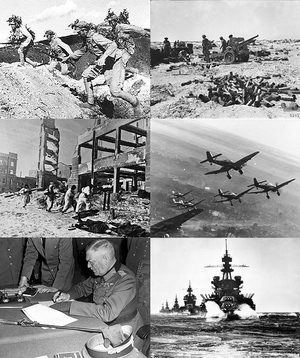
Clockwise from top left: Chinese forces in the Battle of Wanjialing, Australian 25-pounder guns during the First Battle of El Alamein, German Stuka dive bombers on the Eastern Front in December 1943, a US naval force in the Lingayen Gulf, Wilhelm Keitel signing the German Instrument of Surrender, Soviet troops in the Battle of Stalingrad. |
|
|
| Participants |
| Allies |
Axis |
| Commanders and leaders |
Main Allied leaders
 Joseph Stalin
 Franklin D. Roosevelt
 Winston Churchill
 Chiang Kai-shek |
Main Axis leaders
 Adolf Hitler
 Hirohito[b]
 Benito Mussolini |
| Casualties and losses |
Military dead:
Over 16,000,000
Civilian dead:
Over 45,000,000
Total dead:
Over 61,000,000 (1937–45)
...further details |
Military dead:
Over 8,000,000
Civilian dead:
Over 4,000,000
Total dead:
Over 12,000,000 (1937–45)
...further details |
|
| [show]
Campaigns of World War II
|
| Events leading to World War II |
|
|
|
|
| World War II |
| Alphabetical indices |
|
|
| Navigation |
|
|
|
|
|
World War II (often abbreviated to
WWII or
WW2), also known as the
Second World War, was a
global war that lasted from 1939 to 1945, although related conflicts began earlier. It involved
the vast majority of the world's countries—including all of the
great powers—eventually forming two opposing
military alliances: the
Allies and the
Axis.
It was the most widespread war in history, and directly involved more
than 100 million people from over 30 countries. In a state of "
total war", the major participants threw their entire economic, industrial, and scientific capabilities behind the
war effort, erasing the distinction between civilian and military resources. Marked by mass deaths of civilians, including
the Holocaust (in which approximately 11 million people were killed) and the
strategic bombing of industrial and population centres (in which approximately one million were killed, and which included the
atomic bombings of Hiroshima and Nagasaki),
[3] it resulted in an estimated
50 million to 85 million fatalities. These made World War II the
deadliest conflict in
human history.
The
Empire of Japan aimed to dominate
Asia and the
Pacific and was already
at war with the
Republic of China in 1937, but the world war is generally said to have begun on 1 September 1939
[6] with the
invasion of
Poland by
Nazi Germany and subsequent declarations of war on Germany by
France and the
United Kingdom. From late 1939 to early 1941, in a series of campaigns and
treaties, Germany conquered or controlled much of continental Europe, and formed the Axis alliance with
Italy and
Japan. Under the
Molotov–Ribbentrop Pact of August 1939, Germany and the
Soviet Union partitioned and annexed territories of their European neighbours,
Poland,
Finland,
Romania and the
Baltic states. The war continued primarily between the European Axis powers and the coalition of the United Kingdom and the
British Commonwealth, with campaigns including the
North Africa and
East Africa campaigns, the aerial
Battle of Britain, the
Blitz bombing campaign, the
Balkan Campaign as well as the long-running
Battle of the Atlantic. In June 1941, the European Axis powers launched
an invasion of the Soviet Union, opening the
largest land theatre of war in history, which trapped the major part of the Axis' military forces into a
war of attrition. In December 1941, Japan
attacked the United States and
European colonies in the Pacific Ocean, and quickly conquered much of the Western Pacific.
The Axis advance halted in 1942 when Japan lost the critical
Battle of Midway, near
Hawaii, and Germany was defeated in
North Africa and then, decisively, at
Stalingrad in the Soviet Union. In 1943, with a series of German defeats on the
Eastern Front, the
Allied invasion of Sicily and the
Allied invasion of Italy
which brought about Italian surrender, and Allied victories in the
Pacific, the Axis lost the initiative and undertook strategic retreat on
all fronts. In 1944, the Western Allies
invaded German-occupied France,
while the Soviet Union regained all of its territorial losses and
invaded Germany and its allies. During 1944 and 1945 the Japanese
suffered major reverses in mainland Asia in
South Central China and
Burma, while the Allies crippled the
Japanese Navy and captured key Western Pacific islands.
The war in Europe concluded with an
invasion of Germany by the Western Allies and the Soviet Union, culminating in the
capture of Berlin by Soviet troops and the subsequent
German unconditional surrender on
8 May 1945. Following the
Potsdam Declaration by the Allies on 26 July 1945 and the refusal of Japan to surrender under its terms, the United States
dropped atomic bombs on the Japanese cities of
Hiroshima and
Nagasaki on 6 August and 9 August respectively. With an
invasion of the Japanese archipelago imminent, the possibility of additional atomic bombings, and the
Soviet Union's declaration of war on Japan and
invasion of Manchuria,
Japan surrendered on 15 August 1945. Thus ended the war in Asia, cementing the total victory of the Allies.
World War II altered the political alignment and social structure of the world. The
United Nations (UN) was established to foster international co-operation and prevent future conflicts. The victorious
great powers—the United States, the Soviet Union, China, the United Kingdom, and France—became the
permanent members of the
United Nations Security Council.
[7] The Soviet Union and the United States emerged as rival
superpowers, setting the stage for the
Cold War, which lasted for the next 46 years. Meanwhile, the influence of European great powers waned, while the
decolonisation of Asia and
Africa began. Most countries whose industries had been damaged moved towards
economic recovery. Political integration, especially
in Europe, emerged as an effort to end pre-war enmities and to create a common identity.
[8]

